In the midst of this back-to-school season, as kindergarteners leave on a bus for the first time, as middle schoolers hop on public transportation, as college students move into a new home, I am reminded of the mother centuries ago who also witnessed her son moving on from her. St. Monica, whose feast is today, was St. Augustine’s mother. After he left for his own educational and professional exploration, Monica found herself in a solitary state of concern in North Africa, while her son began his life in Rome.
In a time long before social media, telephones, or even the postal service, Monica most likely would have waited weeks or months to hear how her son was, or even if her son was still alive. The agony of this distance and unknowing is unfathomable to those of us who can instantly call or message our children and know within seconds whether they are safe, tired, hurt, angry, joyful, etc. Monica relied simply on her trust in God as her steadfast faith became her assurance.
Monica easily could have decided to ignore her inner worries about her son. She could have remained in Thagaste and safely lived out her life. Instead, she went on the road to follow Augustine. Her pilgrimage, long before the one my fellow pilgrim Jessie Pagan recounts in her own blog essay about Villanova University’s 2026 Women’s Pellegrinaggio Augustiniano, was driven by maternal and spiritual dedication. While Monica’s faith in God was steadfast, presumably, her faith in her son’s choices was not. As we know from Augustine’s Confessions, she had reasons to be concerned! As he recounts, it is her prayers that ultimately led to his conversion and therefore to his leadership in the church.
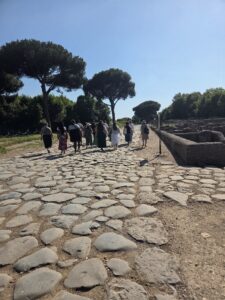
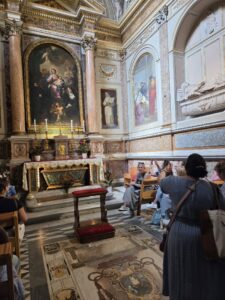
I was fortunate to be on pilgrimage in Italy with Jessie and the 32 other pilgrims from Villanova this past May. We took in awe-inspiring churches and artwork and listened to Augustinian friars. We were welcomed into the homes of Augustinian nuns and ended our journey in Ostia – in the midst of what is now ruins, once a coastal port town. I was struck by my foot touching the ground that Monica and Augustine once touched. The energy felt palpable. The sense of their love and dedication to each other, to God, to their community was abounding.
We learned that we were in the place where Monica and Augustine had one of their last recounted conversations, as detailed in book nine of the Confessions, a beautiful retelling of their tender moments of joined prayer and vision, followed by a loving affirmation by Monica that her greatest desire, her desire for her son to find his faith, had been fulfilled. For Augustine to have written about this conversation in such detail is a grace for us, as readers and spiritual pilgrims. Likewise, it was a graced place to be at the location for our final reflection and the closing out of a week of learning, praying, and community-building.
While Monica found her final place on earth in Ostia, Augustine continued his ministry for many years. He remained in the mission she began with prayers for him. In a similar way, as we look to Monica as a model of faith, of dedication, and of strength, we are called to reflect on her life and her work and look forward to how we can continue to deepen our own sense of Augustinian mission, of ministry rooted in care for others, in seeing out the best for those we love, of trust in God.
I am grateful to be in a role where I am surrounded by people who seek to encourage others, to reach out to those on the margins, to comfort those who grieve. The St. Thomas of Villanova Center for the Common Good, though named for a different Augustinian saint, can look toward St. Monica as an example of fully caring for students, for taking it personally that their time with us is short and important. We seek the example of Monica to trust in God as our groups venture out to learn and grow during immersion experiences, and we seek the example of the community that Monica, Augustine, and their companions forged when we seek time around fire pits and during late night chats, conversing about life, and reflecting on our role in the world. As we enter into Philadelphia, Norristown, or out into Belize, West Virginia, and Los Angeles, we do so with pilgrim hearts, seeking our steps to be reminders that there are many who trod this path before us and who model for us how to remain prayerful, dedicated and caring, as we look to the example of Monica today and for days to come.
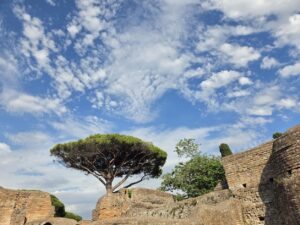
While on pilgrimage with fellow students, colleagues, new friends, and companions, we were asked to reflect in a journal as we journeyed to various locations. I am not great at journaling, I admit. I am more of a visual person, so I snapped pictures: pictures of my fellow pilgrims, of the beautiful churches and streets, of holy sites and everyday objects. In addition, I tried to capture the swaying of trees, the birds in action, and the cats to remember the sounds that enveloped us. The journal prompt for our final day, our day in Ostia, is one I contemplated while reflecting on the life of Monica and Augustine, and the one, as a mother myself, I continue to think about. The prompt — How would you like to be remembered? — is perhaps a daily prayer for each of us.
How do we wish to be remembered today? Is today the day I want seared in someone’s memory? Am I showing my best self? Am I being real and honest? Am I living out the values I wish to model?
I am confident Monica and Augustine were not always perfect on every day. And yet, he remembered her as such. I can’t help but hope my children do the same some day in the (God-willing) very far future. There is something about children and parents that spans the length of time. While I have a variety of memories of my father, the ones I choose to hold tight are the ones of warmth and laughter, of caring, and encouragement. They seem more important than the others. Quite possibly because I know deep down, even in the harder moments, there was love present — a love similar to one Augustine felt from Monica. No matter where we are on our pilgrims’ journey, may we feel love and know love. And ultimately, like St. Monica, may we all be remembered for our love.