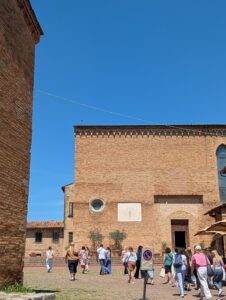
This summer I undertook my first pilgrimage with a community. While I had done solo pilgrimages in the past, I had never done so with others. The Women’s Pellegrinaggio Augustiniano, co-sponsored by Villanova University’s Office of the President, Anne Welsh McNulty Institute for Women’s Leadership, and the Augustinian Institute, took place this past May in Italy. The journey started in Milan and moved slowly down the peninsula to Rome as we visited important sites in the Augustinian tradition, especially for women saints in that tradition like St. Monnica and St. Clare of Montefalco.
Our group of 34 pilgrims included Villanova undergraduate and graduate students, staff, faculty, alumni, and friends of the university. The one thing which we had in common was a curiosity to get to the roots of what exactly it meant to be on an Augustinian pilgrimage together. The conclusion which I drew to this question from the pilgrimage was a deeper wonder at what it means for us to accompany those who do not physically walk but still wander with us: the saints.
Traveling together is an essential part of the Augustinian spiritual life: “Whenever you go out, walk together, and when you reach your destination, stay together (Rule of St. Augustine, 4.2).” We discussed this guideline in the 15-week undergraduate course on Augustinian spirituality and women that preceded the pilgrimage to help prepare the undergraduate students for it. Augustine’s recommendation to walk together and stay together illustrates what living in common means for those who follow the Augustinian way of life. As we traveled as an intergenerational group through Italy, this rule became less of a requirement and more a joy as students and adults grew together through the shared experience. However, what it meant to accompany the past became my central meditation after talking with the undergrads at the shrine of Montefalco.
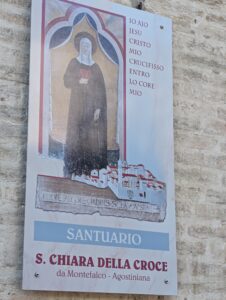
Clare of Montefalco (1268-1308) was a lay Franciscan responsible for bringing her community into the Augustinian Order. She served as prioress for her community, and she also offered support through sharing her visionary experiences of Jesus Christ. Upon her death, her community requested an autopsy, which revealed a miraculous image of Christ on the cross, as well as the physical instruments related to his crucifixion. As the students and I waited patiently for our turn to view her body and the reliquary which held her heart, one of the students turned to me and whispered, Is that really her heart? The question gave me pause; we had talked about the heart in class during the spring term. I answered in the moment not expecting the question to linger in my head as it did. Though the student’s question was a request for information for herself and her peers who huddled around me, it was an invitation for me to reflect more generously on the lessons of Augustine’s Confessions.
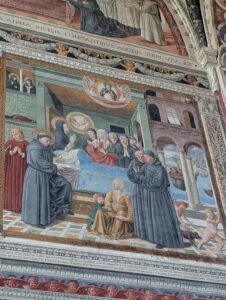
In Confessions 6.2.2, Augustine recollects how Monnica stopped her traditional practice of offering bread and wine at the tombs of the martyrs when banned to do so by Ambrose, bishop of Milan. Augustine “marveled at the attitude she had so readily adopted” (6.2.2; trans. Boulding). In my times re-reading Confessions, I always return to this passage and consider it in connection to Ambrose’s own use of the bodily remains of Sts. Protasius and Gervasius, second century-martyrs, to support his cause in building a church (9.7.16). Monnica’s practice was considered suspicious and Ambrose’s licit. Monnica gave bread and wine, or basics of the Roman pantry. She shared ordinary parts of her life with the publicly proclaimed saints. She humanized the saints, but Ambrose set them apart. Monnica’s example of what it means to journey with both the living and the dead resurfaced on our final night.
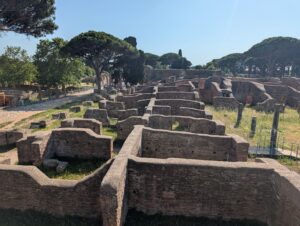
The group traveled in the late afternoon to the archaeological site of the Roman port city of Ostia outside the city of Rome. Monnica died at Ostia and was buried there by her family, as remembered in book 9 of the Confessions. Our pilgrims meandered through the stone ruins, eventually making our way to an ancient tavern. As we sat in the shade recovering from the heat of the sun, members of the pilgrimage shared their final reflections. Huddled in a circle, we heard from people who thought of Monnica, or Augustine, or Clare. Some talked about the joys of conversation. Others told about what they would take spiritually home with them. What lingered for me were the final recorded words of Monnica: “Lay this body anywhere, and take no trouble over it. One thing only do I ask of you, that you remember me at the altar of the Lord wherever you may be” (Conf. 9.11.27). Monnica would have been expected to be buried next to her husband as a fourth-century Roman matron. She instead asks that her sons take her with them in their memory, whenever they went before the altar.
In reflecting after a few months of distance from the trip, I realize why the students’ question lingered in my mind. While the experience of seeing Clare’s heart was exciting as a scholar of medieval Christianity, the relic itself is not what left an impression. As a PhD student who studies the history of Christian spirituality, the mind and heart are sometimes not in common when it comes to considering topics such as Christian devotional practices and relics. I can switch between the student of history and the somewhat skeptical believer. I rarely hold them together in the same figurative hand. As a historical thinker, there is a natural distance between myself and my subjects.
Yet, the open and charitable approach of the students’ question reminded me of the Christian affirmation of the communion of saints. They were trying to understand and meet the life and death of Clare, and the spiritual legacy of Augustine which fused with her story. They were trying not to simply know about her but to feel the humanity of Clare. They modeled what it means to respect the sharing of humanity which transcends even death, just like Monnica shared bread with martyrs or walked in memory with her sons. It was Monnica’s loving attention to both the saints and Ambrose’s words which helped to turn Augustine’s eyes towards Christianity. Likewise, if I had not traveled with others, I would not have been moved by the heart of Clare as I was. With a few months having passed, I do not really think I could give a reliable physical description of the heart or its reliquary. I, however, can describe the sense which I had as I walked up to the glass behind which Clare’s heart was enshrined. In the quiet, I could feel that Clare had followed out of their question. As the sound of their words died, in the quiet, I could imagine the heart beating.